
It is the digital age and digital technology will continue to take over every aspect of business. Business leaders need to find effective ways to stay afloat.

It is the digital age and digital technology will continue to take over every aspect of business. Business leaders need to find effective ways to stay afloat.

Gartner, Inc. recently announced its list of 10 top strategic technology trends of 2023 at the Gartner IT Symposium/Xpo™. Frances Karamouzis, Distinguished VP Analyst at Gartner, explains their list to be strategic, and is “built around three themes — optimize, scale and pioneer — where technologies can help organizations optimize resilience, operations or trust, scale vertical solutions and product delivery, and pioneer with new forms of engagement, accelerated responses or opportunity.”
The top strategic technology trends for 2023 are:
Adaptive AI
“Adaptive AI systems aim to continuously retrain models and learn within runtime and development environments based on new data to adapt quickly to changes in real-world circumstances that were not foreseen or available during initial development. They use real-time feedback to change their learning dynamically and adjust goals. This makes them suitable for operations where rapid changes in the external environment or changing enterprise goals require an optimized response.”
Optimize
Digital Immune System
“CIOs are looking for new practices and approaches that their teams can adopt to deliver that high business value, along with mitigating risk and increasing customer satisfaction. A digital immune system provides such a roadmap. Gartner predicts that by 2025, organizations that invest in building digital immunity will reduce system downtime by up to 80% – and that translates directly into higher revenue.”
Applied Observability
“Observable data reflects the digitized artifacts, such as logs, traces, API calls, dwell time, downloads and file transfers, that appear when any stakeholder takes any kind of action. Applied observability feeds these observable artifacts back in a highly orchestrated and integrated approach to accelerate organizational decision-making.”
AI Trust, Risk and Security Management
“Organizations must implement new capabilities to ensure model reliability, trustworthiness, security and data protection. AI trust, risk and security management (TRiSM) requires participants from different business units to work together to implement new measures.”
Scale
Industry Cloud Platforms
“Industry cloud platforms offer a combination of SaaS, platform as a service (PaaS) and infrastructure as a service (IaaS) providing industry-specific sets of modular capabilities to support specific industry business use cases. By 2027, Gartner predicts that more than 50% of enterprises will use industry cloud platforms to accelerate their business initiatives.”
Platform Engineering
“The goal of platform engineering is to optimize the developer experience and accelerate product teams’ delivery of customer value. Gartner predicts that 80% of software engineering organizations will establish platform teams by 2026 and that 75% of those will include developer self-service portals.”
Wireless Value Realization
“Gartner predicts that by 2025, 60% of enterprises will be using five or more wireless technologies simultaneously. As networks move beyond pure connectivity, they will provide insight using built-in analysis and low-power systems will harvest energy directly from the network. This means the network will become a source of direct business value.”
On the iSeries/AS400, A CDRIVER is a Lawson IBMDB program written in “C Language” and runs on the System i platform.
Its primary use is to retrieve data from DB2 using Structured Query Language (SQL)/Call Level Interface (CLI) Application Program Interfaces (APIs).
Furthermore, Lawson Jobs are using CDRIVER. Each Lawson Job has its own CDRIVER per Data Area or Product Line. Its purpose is to run SQL commands to retrieve database records requested by the job connected to it. The job name will be automatically registered in the CDRIVER joblog and the job that is attached to it may change if REUSE is set to “ON” in the ladb.cfg.

Infor Japan K.K. recently announced that automotive components manufacturer Chuo Spring Co. Ltd. has rolled out Infor SyteLine, Infor’s enterprise resource planning (ERP) solution for the discrete manufacturing industry, to its base in the United States. Per the press release, this roll-out follows a global standards-based model approach with results of faster implementation at its U.S. base, as well as improved accuracy of inventory management. Since its implementation of Infor SyteLine at its Indonesia base in the latter half of 2019, Chuo Spring achieved real-time visualization and improved operations from the head office. In addition, Infor SyteLine has improved operational efficiencies, with the linking of electronic data interchange (EDI) data to order and shipping data resulting in savings of 50 hours per month. Further, as the company moves forward with Infor SyteLine, mutual adoption of initiatives between overseas subsidiaries will lead to the increased competitiveness of overseas bases and the group as a whole.


With Microsoft’s end-of-life for Windows 2012, and Lawson’s end-of-life coming up in 2026, many organizations are considering a move to a cloud solution. And Infor’s Multi-Tenant cloud is a true contender. Here are just a few of the benefits of choosing to move into the Infor Cloud.
Once per year, customers have the ability to request a swap in Infor products. Swappable Infor products include any multi-tenant products that the customer has subscribed to for at least one year. Talk about flexible!
If you are already in the cloud, and looking for a technology swap, contact your Infor Account Executive today! Your AE’s contact information can be found in the Contact widget on your Concierge home page.
Pricing for storage, additional non-production environments, and programmatic access can always be found on Infor’s web page. Non-production environments can be used temporarily as-needed (a minimum of 6 months) to save on costs. Storage can be requested subject to a minimum amount and time. Programmatic access, or the interaction between Infor products and third-party programs, will use the Infor OS service and is priced separately. Again, this pricing is always available on the Infor Docs website.
Severity 1 issues are covered by customer support 24x7x365. Response times are within 30 minutes from Infor’s receipt of the logged request, and they are working to decrease that SLA all the time. They are currently working toward a goal of increasing support for Severity 2 issues to 24×7. And they are improving their response templates to make sure customers are receiving the most accurate and detailed information possible on each ticket.
Infor offers credits if the Multi-Tenant cloud availability dips below a specified threshold. This credit would be calculated by the month.
Infor refers to these ideals as the customer’s “Bill of Rights”. And as great as they are, Infor is constantly working toward improving on these “rights”. Stay tuned! More good news is coming!

Artificial intelligence (AI) and machine learning (ML) are a universal staple in many in consumers’ lives, from streaming service suggestions of what to watch next to GPS route options based on your past behavior. AI can emulate human decision-making from the algorithm-driven foundation of ML that enables the former. We see automation as something that would better our lives by limiting our choices. Whereas in a larger sense, these automation technologies can be used by companies in many aspects of the business – from transporting products to warehouse workers for packing, processing invoices, to assisting with many other repetitive business tasks. It’s clear that AI and ML has made a huge impact in enterprise technology. Tech-driven solutions from these automation tools have helped companies reduce costs, create a more efficient logistics chain, and free up employees to add value to their organizations in other positions. Nate Farshchi, media and telecommunications senior analyst with RSM US LLP, shares an article on BuiltIn – the online community for startups and tech companies – indicating that plenty of strong signals indicate that AI, ML, and automation will play an important role in the future of business. Accenture notes that, currently, “only 12 percent of enterprise applications are utilizing AI and ML at a maturity level which results in a significant competitive advantage.” IDC has also estimated that “90 percent of enterprise applications will be supplemented by artificial intelligence and machine learning (AI & ML) by the year 2025.” Farshchi notes that adopting AI and ML applications is also becoming less expensive and faster because of lower training costs and quicker training periods for their employees. The future of AI, ML, and automation, Farshchi concludes, appears to be bright and has a very high ceiling. Businesses should act now to get ahead with this enterprise technology.

Power outages can happen any time. Depending on your environment, they can be predictable. However, in any power outage, any business is at risk. Productivity comes to a standstill and you have the horror of losing any unsaved on-premise data. One of the easiest solutions to the latter problem is to have your business information on the cloud, especially your enterprise resource planning (ERP) system. Cloud ERP can be accessible over the internet anywhere and in times like sudden power outages, almost everything is stored safely in the cloud for you to recover. BusinessTech, the largest business news website in South Africa, knows that their area is no stranger to power outages. While you may not experience as many power outages where you live, they can still happen and at any time. Experts at BusinessTech share 5 ways that an ERP can help minimize risks and costs when you are in a power outage situation.
If you’re not already in the Cloud ERP space, now may be a good time to look into it instead of later on when it may be too late.
There are some important changes to MSCM v11 that will impact the way handhelds and admins interact with it.
First, the handheld URL has changed. To connect to MSCM, the handheld should connect to mscm_server/mscm. Note that the “mscm” appended to the end of the URL is new.
The configuration has also been moved off the file system and into the database. The configuration can be edited at this URL: http(s)://mscmserver:port/mscm/service/app/login.jsp
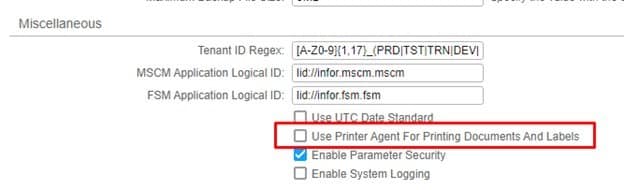
Finally, if you are having trouble printing labels, go to the administrator and check for the flag “Use Printer Agent For Printing Documents And Labels”. This should be unchecked.
Infor recently announced that Switzerland-based Regloplas AG has migrated to the cloud and has gone live with Infor CloudSuite Industrial Enterprise as well as Infor CPQ in the multi-tenant cloud. The temperature control solutions market leader deployed a future-proof ERP (enterprise resource planning) infrastructure to enable scalable, digitized manufacturing processes. Implementation and support was headed by Infor partners AS infotrack AG and AZTEKA Consulting GmbH. Per the press release, Regloplas has achieved strong business growth in recent years, which led to a host of completely new requirements for production and the value chain in order to adapt to the new market environment. New ERP infrastructure was needed that could meet the new challenges and provide Regloplas with easy-to-scale, digital manufacturing. Infor CloudSuite Industrial Enterprise is specifically tailored to the needs of manufacturers and offers a complete solution package for ERP in the multi-tenant cloud. Additionally, Infor CPQ configure price quote has become a critical business solution for Regloplas, with the capability to enable Regloplas to offer its customers highly customizable products.