
844-NOGALIS (844-664-2547)
Nogalis, Inc.
  • Link to Facebook
  • Link to X
  • Link to LinkedIn
  • Link to Mail
  • Company
    • News, Events and Articles
    • About Us
  • Products
    • Infor Lawson Data Archive
    • PeopleSoft Data Archive
    • Oracle Data Archive
  • Services
    • Infor Lawson Support
    • Infor Lawson / CloudSuite Consulting
  • Education & Training
  • Support
  • Contact Us
  • Click to open the search input field Click to open the search input field Search
  • Menu Menu

Archive for category: News

You are here: Home1 / News, Events and Articles2 / News

Why Cloud Migration Services Matter More Than Ever in 2026

News

Cloud migration is no longer a “nice-to-have” IT upgrade—it’s becoming a business necessity in 2026. In a recent article for The AI Journal, technology journalist Erika Balla explains why cloud migration services matter more than ever. For many organizations, the move to the cloud doesn’t start with strategy slides—it starts with frustration: unstable servers, constant restarts, and aging infrastructure that can’t keep up.

At its core, cloud migration means moving applications, data, and infrastructure from on-premises systems to cloud environments. But as Balla points out, it’s rarely a simple lift-and-shift. The process often uncovers outdated systems, bloated data, and legacy apps that need rework before they function properly in the cloud. She outlines common migration types—data, application, infrastructure, and hybrid models—as well as the well-known “6Rs” strategies: rehost, replatform, refactor, repurchase, retire, and retain. Each offers a different path depending on business goals and technical realities.

Of course, the journey isn’t always smooth. Security concerns, compliance requirements, cost overruns, and limited in-house expertise can all complicate migration efforts. That’s why best practices matter: start with a full audit, move in phases, prioritize security, test thoroughly, and monitor cloud spending closely. This is where cloud migration services prove their value. Experienced specialists help reduce downtime, manage risk, ensure compliance, and prevent expensive missteps—freeing internal teams to focus on day-to-day operations.

The payoff? Faster applications, improved scalability, stronger disaster recovery, and more room for innovation. Balla’s message is clear: cloud migration isn’t just a technical shift—it’s a strategic move toward a more resilient, future-ready business.

 

For Full Article, Click Here

02/26/2026
https://www.nogalis.com/wp-content/uploads/2025/04/cloud-computing-it.jpg 334 501 Angeli Menta https://www.nogalis.com/wp-content/uploads/2013/04/logo-with-slogan-good.png Angeli Menta2026-02-26 12:04:242026-02-24 14:07:43Why Cloud Migration Services Matter More Than Ever in 2026

8 ERP security best practices for modern ERP environments

News

Enterprise resource planning (ERP) systems are treasure troves of sensitive business data—which makes securing them a top priority in today’s threat landscape. In a recent TechTarget article, Kevin Beaver of Principle Logic outlines eight practical security best practices for modern ERP environments. With supply chain attacks on the rise and remote access now standard, he argues that ERP security can’t be treated as an afterthought. One key theme: whether your ERP is on-premises or in the cloud, security is still your responsibility. Assuming a SaaS vendor has everything covered is a risky misconception. Even in cloud environments, organizations must stay actively involved in monitoring, access control, and risk management.

Beaver’s first recommendations are foundational: enable multifactor authentication (preferably app- or token-based, not SMS) and enforce strong password policies. Just as critical is staying on top of software updates. Unpatched systems—especially those missing years-old fixes—are easy targets for attackers. Beyond technical controls, he emphasizes people and process. Educate users and make them partners in security. Build and regularly refine a documented incident response plan. Conduct vulnerability scans, penetration tests, and threat modeling to uncover weak spots. For cloud ERP, review vendor SOC 2 reports at a minimum. Ongoing monitoring is also essential. Whether handled in-house or outsourced, organizations need visibility into logs, alerts, and suspicious activity.

Beaver urges companies to take a structured approach: know what assets exist, understand the risks, and act decisively to mitigate them. His bottom line is simple: ERP security doesn’t fix itself. The best time to strengthen it is before a breach forces your hand.


For Full Article, Click Here

02/25/2026
https://www.nogalis.com/wp-content/uploads/2024/12/data-security-it.jpg 360 540 Angeli Menta https://www.nogalis.com/wp-content/uploads/2013/04/logo-with-slogan-good.png Angeli Menta2026-02-25 10:56:092026-02-24 14:02:508 ERP security best practices for modern ERP environments

How to fix certain Lawson LBI reports on dashboard prompting for ID and Password

Articles, Frontpage Article, News

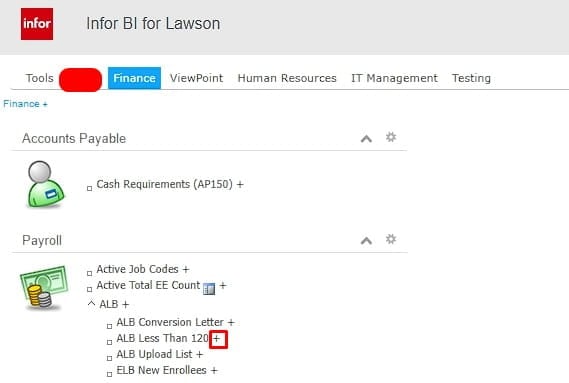
Follow these steps to learn how to fix certain Lawson LBI reports on dashboard prompting for ID and Password. This typically happens after a migration to a new version of LBI. You’ll need to update these report parameters.

First, edit the report on dashboard:

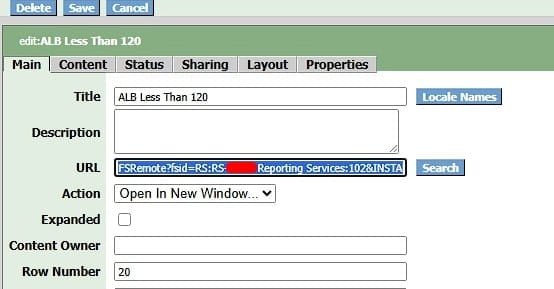
Next, copy the existing URL:

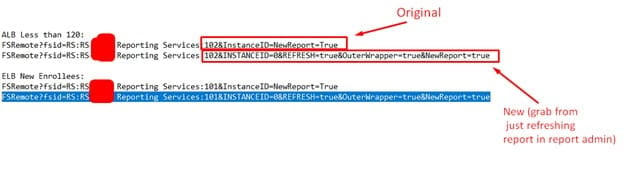
Run the report in Report Admin with data refresh and grab this part of the URL (see screenshot), append it to the end of the original URL above from the report you’re adding it from:

It should like this:

Now it should load properly without asking for credentials.

02/24/2026
https://www.nogalis.com/wp-content/uploads/2026/02/How-to-fix-certain-Lawson-LBI-reports-on-dashboard-prompting-for-ID-and-Password.jpg 470 470 Angeli Menta https://www.nogalis.com/wp-content/uploads/2013/04/logo-with-slogan-good.png Angeli Menta2026-02-24 11:07:472026-02-20 13:12:09How to fix certain Lawson LBI reports on dashboard prompting for ID and Password

ERP in 2026: More AI, more best-of-breed add-ons

News

ERP (enterprise resource planning) systems are getting a serious AI upgrade in 2026—and they may look a lot less “all-in-one” than they used to.

In a recent article for CIO.com, senior writer Grant Gross explains how ERP platforms are evolving from transactional back-office systems into intelligent, data-driven engines. Leaders like Steve Bronson of Southern Glazer’s Wine & Spirits say AI and predictive analytics are becoming deeply embedded in core processes, transforming ERP into a real-time decision platform.

AI is the headline change. Experts predict ERP systems will increasingly automate invoicing, onboarding, reconciliations, and other routine finance tasks. Kirk Teal of Information Services Group says AI will go beyond analytics—detecting anomalies, forecasting outcomes, and even recommending or executing decisions within set guardrails. Lasse Kalkar of LiveFlow adds that finance teams are ready to offload repetitive work to AI agents, while keeping humans in the loop for final review.

At the same time, companies are rethinking the traditional monolithic ERP model. Some are embracing modular, best-of-breed apps layered onto a core system. Andy Sen of AppDirect sees AI making it easier to build custom ERP-related tools instead of relying only on bundled vendor modules.

Still, all-in-one platforms aren’t going away. Many organizations prefer their simplicity, and hybrid ecosystems—core ERP plus specialized add-ons—are emerging as the middle ground.

The takeaway? In 2026, ERP won’t just record what happened. It will help decide what happens next.


For Full Article, Click Here

02/23/2026
https://www.nogalis.com/wp-content/uploads/2016/08/erp-enterprise-resource-planning-it-checklist.jpg 433 650 Angeli Menta https://www.nogalis.com/wp-content/uploads/2013/04/logo-with-slogan-good.png Angeli Menta2026-02-23 13:53:022026-02-24 13:54:39ERP in 2026: More AI, more best-of-breed add-ons

Aurora MySQL InnoDB Overhead

Articles, Frontpage Article, News

If you’ve ever loaded a few terabytes of raw data into MySQL and then scratched your head when the database footprint grew larger than your flat files, you’re not alone. This question came up recently in a real-world migration: flat files totaled about 2.0 TB, but once ingested into MySQL (with no secondary indexes), the database measured 2.24 TB.

So where did the extra 240 GB come from?


The InnoDB Overhead Story

The main culprit is InnoDB’s design. It’s not just storing your rows — it’s storing them with transactional guarantees, recovery mechanisms, and structures for efficient querying. Here’s what adds up:

  1. Page Structure and Fragmentation
  • InnoDB stores data in 16KB pages.
  • Pages aren’t always fully packed, leaving unused space (internal fragmentation).
  • Multiply that by billions of rows, and you’ve got gigabytes of overhead.
  1. Row Format Metadata

Every row comes with extra fields beyond your raw data:

  • Row headers (7–23 bytes).
  • MVCC metadata like DB_TRX_ID and DB_ROLL_PTR to handle concurrent transactions.

A small per-row overhead scales up dramatically in large datasets.

  1. Redo, Undo, and Temporary Logs

InnoDB maintains:

  • Redo logs (ib_logfile0, ib_logfile1) for crash recovery.
  • Undo logs for rollbacks and consistent reads.
  • Temp tablespace (ibtmp1) for operations like sorts.

Even when idle, these files persist on disk.

  1. Fill Factor / Page Utilization

To keep inserts efficient, InnoDB intentionally leaves free space in pages. This means some storage is held open for growth, rather than packed tightly like in a flat file.

  1. Data Type Inefficiencies
  • VARCHAR, TEXT, BLOB, and DECIMAL fields often take up more space in InnoDB than in a plain CSV.
  • Alignment and padding further contribute.
  1. Deleted but Not Reclaimed Rows

If you’ve done heavy deletes or updates, space may not yet be reclaimed. Running OPTIMIZE TABLE can help, though it’s resource-intensive.


How to Measure the Difference

You can check actual table storage in MySQL:

SELECT

table_schema,

table_name,

ROUND(data_length/1024/1024/1024, 2) AS data_gb,

ROUND(index_length/1024/1024/1024, 2) AS index_gb

FROM information_schema.tables

WHERE table_schema = ‘your_db’

ORDER BY data_gb DESC;

Or examine InnoDB tablespace allocation:

SELECT

table_name,

allocated,

file_size,

free

FROM information_schema.innodb_tablespaces;


Putting It Together

The 12% overhead (240 GB on 2 TB raw) is not unusual at all. In fact, it’s right in line with expectations:

Component Typical Contribution
InnoDB page + row overhead 5–15%
Undo/redo logs, temp files 1–5%
InnoDB system metadata <1%
Fill factor, alignment 2–10%

Flat files are lean but fragile. InnoDB adds the structures that make MySQL durable, transactional, and queryable — and that extra space is the price of those guarantees.


Final Takeaway

If your MySQL footprint is a bit larger than your flat file source, don’t panic. That overhead is just InnoDB doing its job. And in large-scale systems, a 10–15% increase is expected — and often well worth the trade-off for reliability and performance.

02/20/2026
https://www.nogalis.com/wp-content/uploads/2026/02/Aurora-MySQL-InnoDB-Overhead.jpg 470 470 Angeli Menta https://www.nogalis.com/wp-content/uploads/2013/04/logo-with-slogan-good.png Angeli Menta2026-02-20 08:44:132026-02-13 12:47:09Aurora MySQL InnoDB Overhead

The Enterprise AI Revolution Is Boring, and That Is What Makes It Work

News

When people talk about the artificial intelligence (AI) revolution, they usually imagine flashy chatbots or Super Bowl–ready demos. But as Mark Talbot,  Director of Architecture and AI at Appian, points out inhis article on ERP Today, the AI that’s truly transforming businesses is… boring. Quiet, reliable, and deeply embedded into core workflows, this is where real ROI happens.

Talbot calls it “boring AI” because it focuses on the back-end processes that actually run the business: enterprise resource planning (ERP) systems, scheduling, billing, and cross-platform coordination. The flashy AI pilots—generative chat tools or marketing-focused bots—are failing 95% of the time because they aren’t integrated into daily work. Employees rarely use them, and executives end up measuring hype instead of measurable outcomes. The magic of boring AI is that it works where it counts. In ERP environments, it reconciles data across systems, automates financial reporting, streamlines supply chain operations, and handles repetitive administrative tasks. For example, a healthcare provider using AI to automate patient intake and documentation reduced waitlist times by over 80%—all without dramatic fanfare. Talbot emphasizes that the real value of AI comes from embedding it into existing processes, not forcing users to adopt separate tools. Governance, audit trails, and compliance should be built in from day one, making AI trustworthy and risk-free. Low-code platforms often make this easier, letting organizations maintain transparency and human oversight without slowing adoption.

The takeaway for IT leaders: the AI worth investing in isn’t flashy—it’s operational. It quietly accelerates ERP-driven finance, HR, and supply chain processes, reduces errors, ensures compliance, and frees teams to focus on higher-value work. In other words, boring AI is the AI that works.


For Full Article, Click Here

02/19/2026
https://www.nogalis.com/wp-content/uploads/2025/11/AI-erp-it.jpg 334 500 Angeli Menta https://www.nogalis.com/wp-content/uploads/2013/04/logo-with-slogan-good.png Angeli Menta2026-02-19 10:49:492026-02-13 13:31:41The Enterprise AI Revolution Is Boring, and That Is What Makes It Work

Infor Named a Leader in 2026 Gartner Magic Quadrant for Configure, Price, and Quote Applications

News

Infor was recently named a Leader in the 2026 Gartner Magic Quadrant for Configure, Price, and Quote (CPQ) Applications. According to their press release and the report by Gartner, Infor was recognized for both its “completeness of vision” and its “ability to execute.” Gartner defines Leaders as vendors that successfully deliver on their vision through strong products and services, proven large-scale deployments, solid financial performance, and consistently high customer satisfaction. Infor’s CPQ solution is designed to provide an intuitive, visual user experience that enables companies to configure complex products quickly and accurately. Built on the Infor cloud platform powered by Amazon Web Services and Infor OS technology, the solution offers industry-specific capabilities without requiring extensive customizations or integrations. This foundation allows organizations to streamline sales processes, reduce errors, and accelerate deal closures. Ron Eismann, Vice President and General Manager of Infor CPQ, said the recognition reflects the company’s continued focus on innovation and excellence in CPQ solutions. He emphasized Infor’s commitment to enhancing configuration, pricing, and quoting capabilities to help customers across industries optimize sales operations and drive growth. The company also highlighted the growing importance of how products are sold, noting that modern buyers expect personalized offerings delivered quickly, accurately, and affordably. Infor CPQ supports sales teams, partners, and distributors by automating manufacturing instructions, increasing quote volume, improving upsell opportunities, and accelerating new product introductions. Overall, the announcement positions Infor as a leading provider helping businesses modernize and scale complex sales processes.


For Full Article, Click Here

02/18/2026
https://www.nogalis.com/wp-content/uploads/2013/04/Infor__Logo.jpg 566 565 Angeli Menta https://www.nogalis.com/wp-content/uploads/2013/04/logo-with-slogan-good.png Angeli Menta2026-02-18 09:29:512026-02-13 13:31:25Infor Named a Leader in 2026 Gartner Magic Quadrant for Configure, Price, and Quote Applications

PCARD issue- GL165 error file missing

Articles, Frontpage Article, News

Problem:

I was able to access the QA site and see the JE, however there is an issue.  I am not seeing the “error” report for GL165 that we would normally see in v9 production. This is the report that tells us which records have an error and what the error is.

How do we see the error report?  Is this a setting somewhere?


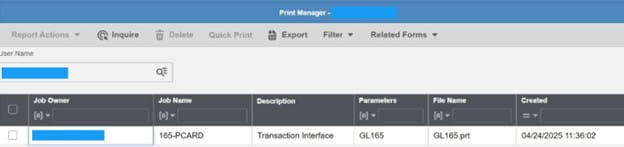
Below is an example from v 10 QA.  The test JE has an error, and the GL165 report shows that there is an error, but it doesn’t tell me which record has the issue:


Resolution:

To resolve this, simple give your user access to the role which gives access to the IFTR.1 files that generate the error files. Then have the user run the job again.

02/17/2026
https://www.nogalis.com/wp-content/uploads/2026/02/PCARD-issue-GL165-error-file-missing.jpg 470 470 Angeli Menta https://www.nogalis.com/wp-content/uploads/2013/04/logo-with-slogan-good.png Angeli Menta2026-02-17 10:37:562026-02-13 12:43:53PCARD issue- GL165 error file missing

How ERP, AI Can Improve Logistics and Operations Efficiency

News


Artificial Intelligence (AI) is no longer just a “nice-to-have” in logistics—it’s becoming a core driver of operational efficiency when integrated with enterprise resource planning (ERP). In a recent ERP Today article, Chris Vavra explains how manufacturers and distributors are combining AI with ERP to reduce costs, improve delivery performance, and stay resilient amid supply chain disruptions.

Companies like Aptean are embedding AI directly into transportation, warehouse, and demand management workflows, moving operations from reactive problem-solving to continuous optimization. For example, a midmarket food and beverage producer saw a 12% drop in empty miles, 9% lower fuel spend, and 20% better on-time delivery within six months by integrating AI-driven route optimization into its ERP. Similarly, warehouse management systems with AI are reallocating labor dynamically, boosting picking productivity.

For IT leaders, this shift changes daily responsibilities. Teams focus less on reconciling siloed data and more on validating AI recommendations, fine-tuning constraints, and managing exceptions that require human judgment. Early adopters emphasize the need for disciplined data governance, master data standardization, and phased rollouts—starting with high-impact areas like route optimization before scaling to predictive inventory and warehouse orchestration.

Vavra also notes that vendor evaluation is critical: leaders should prioritize transparent AI models, ERP integration, industry-specific accelerators, and continuous model tuning. Ultimately, ERP platforms that unify logistics data and embed AI natively will define the next wave of competitive advantage, while organizations that delay data cleanup or integration risk falling behind.


For Full Article, Click Here

02/16/2026
https://www.nogalis.com/wp-content/uploads/2020/08/ERP-eCommerce-logistics.jpg 400 600 Angeli Menta https://www.nogalis.com/wp-content/uploads/2013/04/logo-with-slogan-good.png Angeli Menta2026-02-16 10:51:462026-02-06 12:10:10How ERP, AI Can Improve Logistics and Operations Efficiency

How to reorganize or modify Columns in LBI Maintain Reports

Articles, Frontpage Article, News

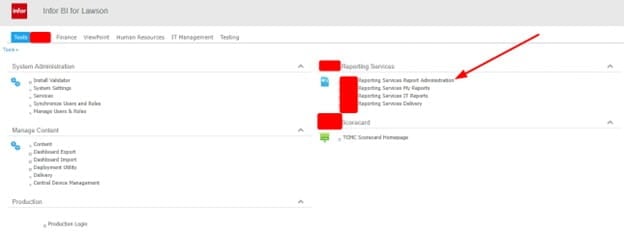
Follow the steps below to learn how to reorganize or modify your columns in (Lawson Business Intelligence) LBI Maintain Reports.


Problem:

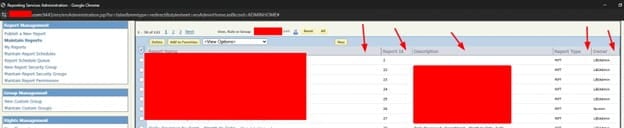
You’re an admin for Lawson LBI but you want to reorganize the Maintain Reports columns like the ones shown below:


Solution:

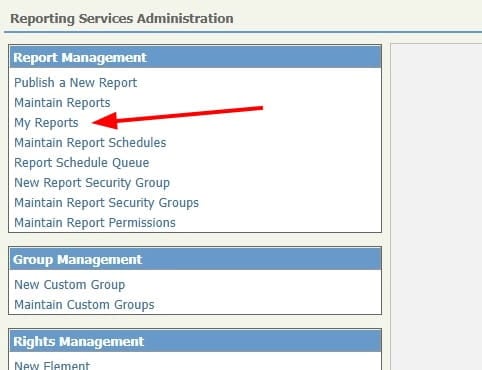
There is a simple way to do this. Just follow these steps.

  1. First, log in to LBI and open your Report Administrator:
  2. Next, go to My Reports on the side bar:
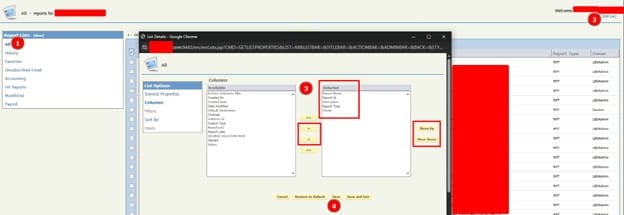
  3. Make sure “ALL” is selected under the left column under Report Lists
    1. Click “Edit List” on the top right and reorganize the columns, then click save.

Go back to Maintain Reports and you should see your new columns!

02/13/2026
https://www.nogalis.com/wp-content/uploads/2026/02/How-to-reorganize-or-modify-Columns-in-LBI-Maintain-Reports.jpg 470 470 Angeli Menta https://www.nogalis.com/wp-content/uploads/2013/04/logo-with-slogan-good.png Angeli Menta2026-02-13 08:32:272026-02-06 11:42:28How to reorganize or modify Columns in LBI Maintain Reports
Page 12 of 232«‹1011121314›»

LEGACY ERP DATA ARCHIVE SOLUTION


Discover how our clients are leveraging AWS services to archive their Legacy ERP data and provide ubiquitous access to users via a light-weight, secure, and read-only web interface. Secure, Fast, Reliable, and Cost Effective. That is the promise of APIX. Follow the link below to find out more and book a discovery call with our data archive specialist.

BOOK DEMO

© Copyright - Nogalis, Inc. 2024
  • Legal
  • Privacy
  • Contact Us
Scroll to top Scroll to top Scroll to top