844-NOGALIS (844-664-2547)
Nogalis, Inc.
  • Link to Facebook
  • Link to X
  • Link to LinkedIn
  • Link to Mail
  • Company
    • News, Events and Articles
    • About Us
  • Products
    • Infor Lawson Data Archive
    • PeopleSoft Data Archive
    • Oracle Data Archive
  • Services
    • Infor Lawson Support
    • Infor Lawson / CloudSuite Consulting
  • Education & Training
  • Support
  • Contact Us
  • Click to open the search input field Click to open the search input field Search
  • Menu Menu

Archive for category: Frontpage Article

You are here: Home1 / News, Events and Articles2 / Frontpage Article

Transitioning Open AP from one ERP to another

Articles, Frontpage Article, News

Things to consider:

  1. Can you pay off all your existing AP prior to transitioning to a new system?
    1. This is preferred whenever possible and start your new ERP with fresh AP
  2. Consider the length of the address fields in your new ERP
    1. Do you need to come up with some abbreviations that work throughout your addresses in the new system?
    2. Have you used abbreviations you no longer need to use and therefore want to undo your abbreviations and make them full words in your new system?
    3. Do you have duplicate addresses that need to be consolidated prior to transitioning? If you are moving off of Lawson, Vendor locations often have duplicate addresses which other ERP systems can’t accept
  3. Cleaning up of inactive Vendors or addresses
    1. This is work that should be done now instead of waiting to the last minute. Paying a consultant to clean up your addresses is expensive.  Hire a temp now and get it done early and less expensive.
  4. Is there anything special about your AP processing that needs to be considered when changing ERP systems?
 

11/01/2019
https://www.nogalis.com/wp-content/uploads/2019/10/Transitioning-Open-AP-from-one-ERP-to-another.jpg 470 470 Angeli Menta https://www.nogalis.com/wp-content/uploads/2013/04/logo-with-slogan-good.png Angeli Menta2019-11-01 08:23:062019-10-31 14:23:15Transitioning Open AP from one ERP to another

BL vs. BR What are the major differences?

Articles, Frontpage Article, News

BL vs. BR What are the major differences?

As a summary, BR allows for different billing options that are not only item – Quantity times Price to invoice.

BL allows for creating automatic recurring invoices by running a job that creates the invoices.

BR has jobs that will book the revenue recognition as defined for the contract


Feature / Module BL

(Billing)

BR

(Billing & Revenue Recognition)

Using IC for item tracking Y N
Can bill ad-hoc Items Y N
Can Set up Products for billing Y – in IC Y
Can you Print an Invoice to send to the customer Y Performa only
Interfaces to AR Y Y
Requires Activity Module N Y
Auto Create Revenue Recognition entries N Y
Uses Allocations to create Revenue Recognition Entries Y N
Has an Invoice Entry form that looks like an invoice Y N
Create Recurring Invoices Y for various intervals N
Cost Plus Billing Y – based on pricing Y
Pass Thru Billing Y Y
Time and Materials Billing Y Y
Units of Production Billing Y Y
User-Defined Billing Needs to have an item with Quantity times rate associated with invoiced lines Y
Milestone Billing Y- if there isn’t a system generated trigger for the milestone, any invoice item quantity*Price invoice can be created Y – needs to be triggered by something


10/29/2019
https://www.nogalis.com/wp-content/uploads/2019/10/BL-vs-BR-What-are-the-major-differences-.jpg 470 470 Angeli Menta https://www.nogalis.com/wp-content/uploads/2013/04/logo-with-slogan-good.png Angeli Menta2019-10-29 08:03:542019-10-29 12:21:07BL vs. BR What are the major differences?

Custom Scripting in IPA

Articles, Frontpage Article, News

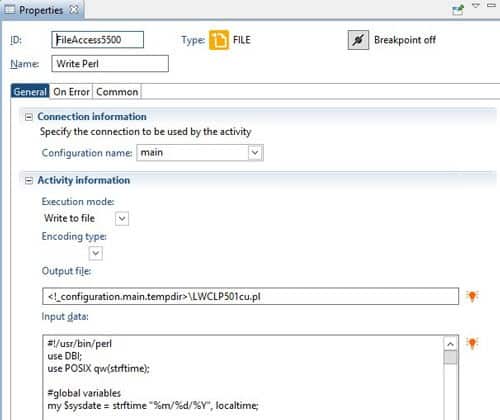
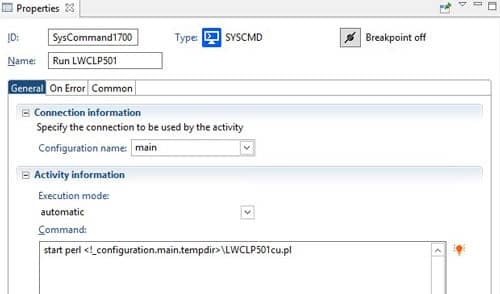
Sometimes complex IPA flows can become cumbersome to maintain, or they can experience degraded performance for large record sets. One way to combat these issues is to create custom scripts within your flows to do the “heavy lifting” of the process. Our favorite scripting language to use is Perl, because it is simple, doesn’t have to be compiled, and is already installed on your Landmark and LSF servers. We use a File Access node to create the script at runtime. This works best because it is more secure and subject to versioning (remember, Perl doesn’t have to be compiled), and you can put flow variables right into your script. To do this type of scripting, you will create your script in a File Access node, and then run it in a System Command node. It is important to note that this will not work in a cloud multi-tenant environment, because system command nodes are not allowed.

10/23/2019
https://www.nogalis.com/wp-content/uploads/2019/10/Custom-Scripting-in-IPA.jpg 470 470 Angeli Menta https://www.nogalis.com/wp-content/uploads/2013/04/logo-with-slogan-good.png Angeli Menta2019-10-23 08:04:162019-10-22 11:17:10Custom Scripting in IPA

Landmark Security Access

Articles, Frontpage Article, News

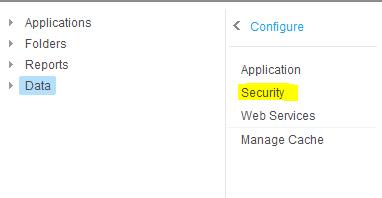
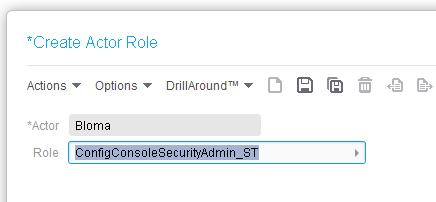
To maintain Landmark Security (classes and roles), in the Gen environment in Rich Client, go to Start > Configure > Security.  If you don’t see the Security or Configure, you will need to have your Security Administrator give you access to it.  The Infor delivered role for this is “ConfigConsoleSecurityadmin_ST”.  Have that role added to your account and wait about 30 minutes for the sync to complete.

10/16/2019
https://www.nogalis.com/wp-content/uploads/2019/10/Landmark-Security-Access.jpg 470 470 Angeli Menta https://www.nogalis.com/wp-content/uploads/2013/04/logo-with-slogan-good.png Angeli Menta2019-10-16 07:31:272019-10-15 09:35:30Landmark Security Access

IPA Dynamic Commands

Articles, Frontpage Article, News

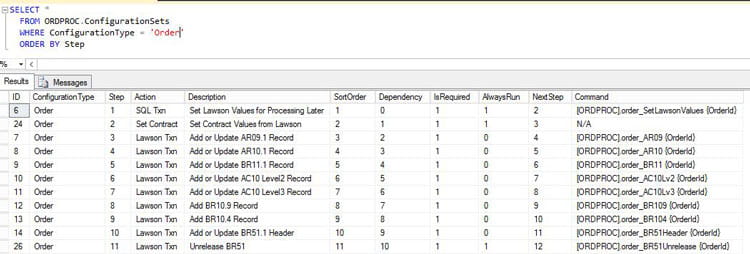
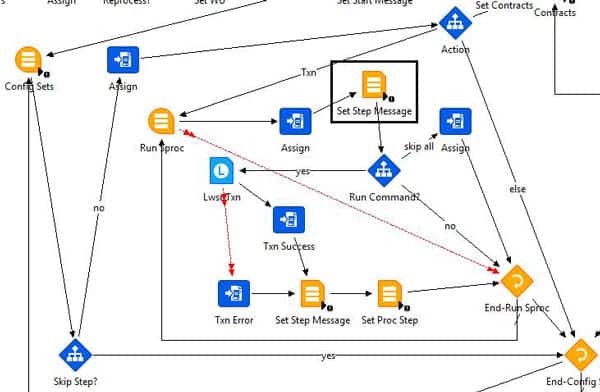
One way to control the “clutter” on your more complex IPA processes is to utilize the concept of “Dynamic Commands”.  Many times your flows will follow a pattern of reading some sort of data, validating/manipulating the data, then taking action on that data.  You can move much of this work into Stored Procedures and set up a configuration table to tell your flow which command to execute next.  This method also allows for more granular error handling and logging.

Here is a sample configuration table and flow.  The flow will read this in and follow each step in order, and use a SQL Query node to get the command text.  The Action field shows what type of action will be completed once the stored procedure brings back the command.

10/09/2019
https://www.nogalis.com/wp-content/uploads/2019/10/IPA-Dynamic-Commands.jpg 470 470 Angeli Menta https://www.nogalis.com/wp-content/uploads/2013/04/logo-with-slogan-good.png Angeli Menta2019-10-09 08:22:552019-10-08 12:26:12IPA Dynamic Commands

New Level Addresses

Articles, Frontpage Article, News

When changing level addresses on GL20 or AC10 make sure to specify all the level addresses, not just the ones that might have changed.

When you create the file for uploading, make sure to have the first level first, the second level next and so on until all levels are rebuilt.  If you try to change an address to one which has upper levels that did not exist in the old system, you will get errors.

Just like building the level addresses, you start with level 1, add a level 2 to an existing level 1 and so on.  Same thing when you rebuild the addresses – make sure to rebuild level by level.

10/04/2019
https://www.nogalis.com/wp-content/uploads/2019/10/New-Level-Addresses.jpg 470 470 Angeli Menta https://www.nogalis.com/wp-content/uploads/2013/04/logo-with-slogan-good.png Angeli Menta2019-10-04 09:53:292019-10-03 13:14:59New Level Addresses

Updating Landmark Main Configuration Set After AD FS Implementation

Articles, Frontpage Article, News

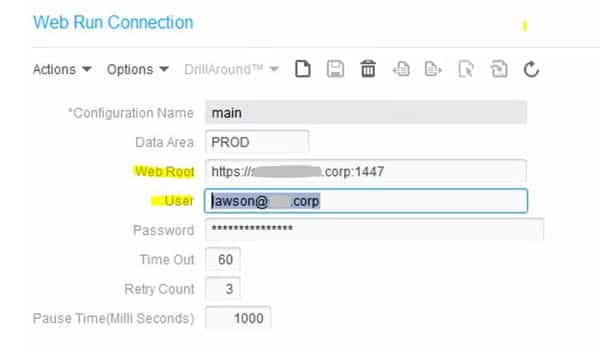
After AD FS is implemented for your Landmark and LSF environments, Landmark will need to connect to the LSF server using the thick client URL and the user principal name of your admin account.  This means that all of your LSF connections will need to be updated in Rich Client, including the Infor Lawson Connection, File Activity Connection, System Command Connection, and Web Run Connection.  You will need to update the Web Root in each of these connections to the Thick Client URL, which is most likely your LSF server URL with port 1447 (i.e. https://lsf.company.com:1447).  Check with your installer to verify the port.  The User will need to be updated to the UPN value, for instance lawson@company.com.

09/30/2019
https://www.nogalis.com/wp-content/uploads/2019/09/Updating-Landmark-Main-Configuration-Set-After-ADFS-Implementation.jpg 470 470 Angeli Menta https://www.nogalis.com/wp-content/uploads/2013/04/logo-with-slogan-good.png Angeli Menta2019-09-30 07:03:272019-09-27 14:00:57Updating Landmark Main Configuration Set After AD FS Implementation

Chart of Accounts when using Activities

Articles, Frontpage Article, News

The Chart of accounts is recommended to be consistent for GL and Activities.  The Activity field, when populated, already differentiates the JE entry line from one to the same account without an activity specified.  This allows for easily determining how much was booked to a specific account and also split the bookings to a specific account into project related or not.

Account Categories in the AC module also allow you to have a separate chart of accounts, if desired, from your GL Chart of Accounts.

Since an account category is required when an activity is entered, it allows for a separation of the GL and AC charts if separation is desired.

Many users default in the Account Category so this value doesn’t have to be specified on each transaction that uses an activity throughout the system.  The defaulting could occur on GL20 instead of GL00 if the accounting unit used in the transaction would alter the way you would account for the project/activity posting.

09/24/2019
https://www.nogalis.com/wp-content/uploads/2019/09/Chart-of-Accounts-when-using-Activities.jpg 470 470 Angeli Menta https://www.nogalis.com/wp-content/uploads/2013/04/logo-with-slogan-good.png Angeli Menta2019-09-24 08:09:332019-09-23 20:47:15Chart of Accounts when using Activities

Creating a “Bursted” Income Statement

Articles, Frontpage Article, News

To create an income statement for some accounting units, create an Accounting Unit list on MX10 that includes the companies and accounting units that you want to include in the report. Specify that list when running the GL293 and presto – an Income Statement with just those company-accounting unit combinations desired.

This can also be done by creating company groups if the “bursting” should be done by different companies.

A Level group can also be used which is great if one of your Accounting Unit levels signifies a reporting level.  As with the MX10 list, using RW70 level groups can also create a “bursting” effect to the GL293 Income Statement report.

Of course, creating different RW100 reports can also create the same effect and can be run together as a whole on RW100 by specifying a Report Group for example.  Use the same Format for all of the reports, and create different Row definitions that allow you to “burst” the income statement into different accounting groups.

09/19/2019
https://www.nogalis.com/wp-content/uploads/2019/09/Creating-a-“bursted”-Income-Statement.jpg 470 470 Angeli Menta https://www.nogalis.com/wp-content/uploads/2013/04/logo-with-slogan-good.png Angeli Menta2019-09-19 08:18:482019-09-18 16:23:34Creating a “Bursted” Income Statement

Landmark Update Fails with Exit Code 2

Articles, Frontpage Article, News

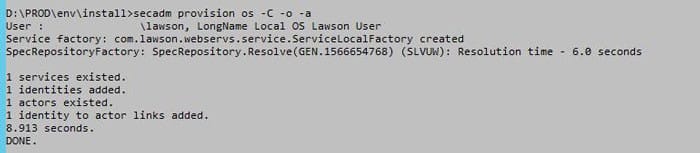
If install-lpa.pl fails with exit code 2, make sure your OS account is configured. To configure the OS account, type command secadm provision os-C -o -a in a Landmark command window.  Then try restarting the Landmark update.


09/16/2019
https://www.nogalis.com/wp-content/uploads/2019/09/Landmark-Update-Fails-with-Exit-Code-2.jpg 470 470 Angeli Menta https://www.nogalis.com/wp-content/uploads/2013/04/logo-with-slogan-good.png Angeli Menta2019-09-16 07:18:042019-09-13 13:21:42Landmark Update Fails with Exit Code 2
Page 96 of 106«‹9495969798›»

LEGACY ERP DATA ARCHIVE SOLUTION


Discover how our clients are leveraging AWS services to archive their Legacy ERP data and provide ubiquitous access to users via a light-weight, secure, and read-only web interface. Secure, Fast, Reliable, and Cost Effective. That is the promise of APIX. Follow the link below to find out more and book a discovery call with our data archive specialist.

BOOK DEMO

© Copyright - Nogalis, Inc. 2024
  • Legal
  • Privacy
  • Contact Us
Scroll to top Scroll to top Scroll to top