
According to Gartner research, over 70 percent of ERP (Enterprise Resource Planning) initiatives are unlikely to achieve their business objectives. An article from CIO Africa highlights the high failure rate and risks associated with ERP projects, emphasizing that many fail not because of technology but due to poor governance, lack of internal ownership, and insufficient visibility into business goals. The notable example of SPAR’s $88.7 million SAP write-off underscores the potential for significant disruption and financial loss when implementations go wrong. Gartner research indicates over 70% of ERP initiatives do not meet their objectives, often due to issues like scope creep, misaligned vendors, and unclear success definitions. The article stresses that effective governance is critical for success and should be viewed as an executive responsibility, not just administrative tasks. Building a strong governance framework involves establishing clear accountability, surfacing risks early, and ensuring vendors are contractually aligned with business outcomes. The CIO’s role is pivotal but challenging, often caught between managing ongoing operations and leading transformation efforts without enough support. Recent failures, such as Birmingham City Council’s £100 million Oracle project, exemplify systemic governance and vendor management flaws. The key to turning around ERP projects lies in restoring visibility, accountability, and control through structured governance, enabling faster decision-making and early problem detection. Ultimately, the article advocates for proactive governance as a foundation for operational resilience and project success, emphasizing that while success cannot be outsourced, it can be achieved through proper structures and leadership.

 

For Full Article, Click Here

Problem:
After user provisioning, your user cannot run batch jobs. When they click on submit and then submit in the pop-up box they get a security violation error. If the batch role is assigned to them that is not the problem. The error message is likely due to the job queue’s status is secure.


Resolution:
The “batchrole” should be assigned to the users. This role only works if only one queue is defined which is usually the ******* job queue. If multiple job queues are defined then go into the “batch” security class under the ENV profile and add each job queue to the class.

Transitioning to enterprise resource planning (ERP) systems such as SAP S/4HANA and Infor CloudSuite requires enhanced testing processes, as the rise in update frequency—from annual to monthly releases—makes traditional testing methods more challenging. An article from ERP Today discusses strategies for safeguarding and maximizing investments in Enterprise Resource Planning (ERP), such as SAP S/4HANA or Infor CloudSuite. As frequent updates and complex application landscapes become the norm, organizations face increased challenges in ensuring software quality and stability. Colin Armitage, CEO of Original Software, emphasizes that their low-code/no-code testing platform simplifies automation by avoiding the pitfalls of traditional code-based solutions, making testing more accessible and adaptable. The platform efficiently manages timing issues and supports a wide range of applications, including legacy systems and multiple ERP environments, facilitating seamless end-to-end process testing across diverse tools. With the rise of rapid, monthly ERP updates, traditional testing approaches are no longer viable. Organizations must prioritize critical process automation—creating “survival packs” of tests for core functions—and consider targeted support services to accelerate testing efforts. Armitage also notes the strategic role of AI in improving test readability and efficiency, exemplified by cost savings at Costco. Finally, the article underscores the importance of building a compelling business case for testing investments, especially as the frequency of software updates increases. Partnering with experienced professionals like your current managed services provider or providers like Original Software helps companies adapt to the fast-changing landscape, mitigate risks, and ensure their ERP investments deliver ongoing value.


For Full Article, Click Here

These are instructions for copying user jobs (by user) between environments.  This will NOT allow you to copy jobs between environments on different versions of LSF of Lawson applications if the job parameters have changed between versions.

  1. Run listusermap in both environments and make note of the NTID for the user in each environment
  2. In the source environment, run the command
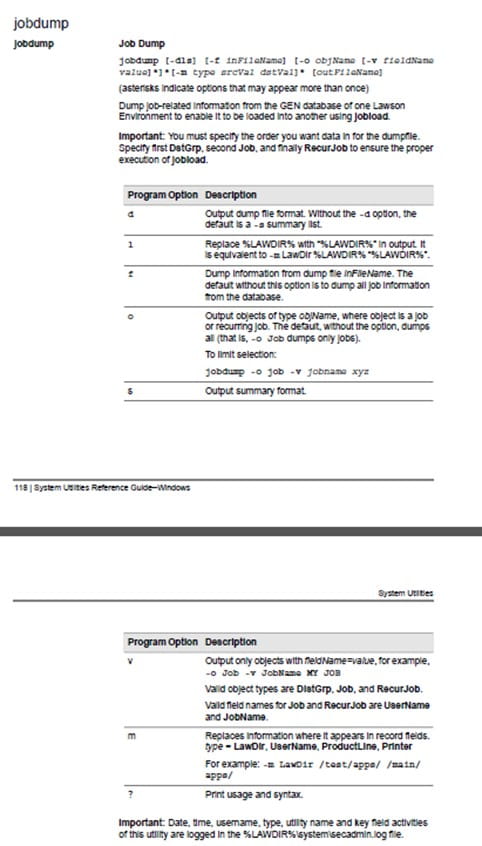
jobdump –d –o job –v UserName “DOMAIN\UserName” outputfile
  1. Open the output file created by the command in a text editor
    1. Update any references to the NTID from the source system with the NTID of the destination system
    2. Make any directory structure changes as needed (i.e. change “D:\lsfprod to D:\lsftest”)
  2. Copy the output file to the destination system
  3. In the destination environment, run the command
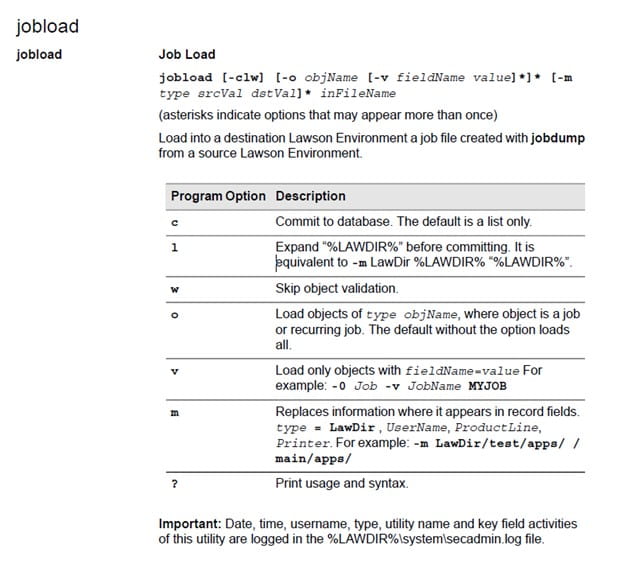
jobload –c –o job inputfile


More on jobdump/jobload


Higher education institutions encounter significant challenges with traditional enterprise resource planning (ERP) systems during mergers, leading to integration delays, increased costs, and loss of institutional identity due to the systems’ inadequacy in addressing the unique cultural and operational needs of academic institutions. In an article on ERP Today by CEO Mark Vigoroso, it highlights that traditional monolithic ERP platforms are ill-suited for the complexities of higher education consolidations. Typical mergers result in prolonged, costly, and disruptive integration processes, often taking 3-5 years, with escalating costs, staff resistance, compliance risks, and loss of institutional identity. These issues lead to operational inefficiencies, financial instability, and competitive disadvantages. To overcome these hurdles, the article advocates for a shift towards composable, cloud-native ERP solutions like Unit4 ERPx. Such systems are modular and flexible, enabling institutions to integrate gradually while preserving unique campus cultures and operational workflows. This approach allows faster integration—up to 60% quicker—reducing timelines to 12-18 months and lowering total ownership costs. It also supports compliance with diverse regulatory requirements and facilitates selective integration based on priority areas. Key recommendations for ERP decision-makers include prioritizing rapid deployment capabilities, designing systems that maintain institutional diversity, and ensuring compliance flexibility. Emphasizing speed, cultural preservation, and adaptability can help universities realize merger benefits more effectively and maintain their competitive edge amid declining enrollments and rising operational pressures.


For Full Article, Click Here

Traditional enterprise resource planning (ERP) systems are becoming digital dead weight. In a recent article by ERP Today’s CEO Mark Vigoroso, he explains why more organizations are ditching monolithic platforms in favor of composable ERP—modular, flexible systems built for change. Historically, companies showcased large, customized ERP implementations that were rigid and difficult to adapt. However, market data indicates a strong move toward composable ERP solutions, with 76% of IT decision-makers aware of them and 84% planning investments, reflecting a rapid industry transition. Traditional ERP platforms, designed for slower-paced business environments, often require extensive customization, leading to costly and time-consuming upgrades. In contrast, composable ERP leverages APIs and microservices, enabling businesses to quickly add, swap, or modify modules without disrupting the entire system. This approach aligns with the modern need for agility in fast-changing markets. Nextworld exemplifies this shift by separating applications from underlying technology, allowing seamless updates and future-proofing. Its enterprise no-code platform empowers business users to develop and modify applications independently, reducing reliance on IT and avoiding technical debt. The company advocates for the “Clean ERP Method,” which modernizes systems without complete replacements, supporting integration and evolution. The article emphasizes that organizations sticking to legacy, monolithic ERP are becoming increasingly obsolete. Future-ready companies will adopt composable platforms that facilitate rapid application assembly, decompose and recompose solutions as needed, and create ecosystems of specialized tools. For ERP leaders, this means shifting focus from static functionalities to adaptable, integrated ecosystems—prioritizing platform thinking, reducing technical debt, and enabling seamless integration of best-of-breed solutions through open standards.


For Full Article, Click Here

Problem:

You are having this issue: I’m getting a reorg error when trying to Activate a CTP

“ERROR – Reorg control file ‘D:/lawson/db/APPS10/reorg.cntl’ exists.  It appears the database is in the midst of a reorganization.  Please complete before Activating.”


Resolution:

Follow these steps to resolve the error.

  1. In LID, run this command: dbreorg -d <Enter_Your_Productline_Here>
  2. Once it completes, run the lawappinstall again:
    1. perl %GENDIR%/bin/lawappinstall activate <productline>
  3. After this, run the verifymsf2000 to validate the dbdict and database are in sync:
    1. %gendir%/bin/Verifymsf2000 -u <your_lawson_user> -p <your_lawson_password> <your_productline>

This usually occurs when a reorg wasn’t completed previously on another CTP. Good luck!

Greenfield ERP (enterprise resource planning) migrations may offer a fresh start, but they often come at the cost of losing critical historical data and institutional knowledge, putting years of business intelligence at risk. In an article by CEO Mark Vigoroso from ERP Today, he challenges the conventional wisdom favoring greenfield ERP migrations, which treat new implementations as entirely fresh starts and often discard valuable legacy data. While greenfield approaches are promoted as a way to eliminate outdated code and modernize systems, they risk erasing decades of business intelligence embedded in legacy systems—such as custom processes, historical performance patterns, and institutional knowledge crucial for informed decision-making. Vigoroso highlights that many organizations, especially those with complex, decentralized operations, rely heavily on historical data to understand market trends, supplier performance, and process efficiencies. Discarding this data in pursuit of a “clean slate” can lead to significant losses in operational insight, as exemplified by companies like a pharmaceutical firm and a manufacturer that lost critical process and supplier data. The article advocates for a more nuanced migration strategy that preserves legacy data and business context. Data Migration International’s JiVS IMP platform exemplifies this approach, enabling organizations to decommission legacy systems while maintaining complete, compliant access to historical information. This hybrid method combines the benefits of modern ERP systems with the retention of valuable institutional knowledge, reducing costs and risk without sacrificing operational agility. Vigoroso urges tech leaders to move beyond binary migration choices and adopt intelligent, data-preserving strategies. He recommends establishing governance frameworks and data archaeology assessments to identify critical historical patterns before system decommissioning. Ultimately, successful ERP transformations will be those that integrate modern capabilities with a strategic preservation of legacy data, viewing it not as technical debt but as a source of competitive advantage.


For Full Article, Click Here

Below is a useful tip for using the field prefix to search for a column in SQL

Clicking Ctrl+Shift+O in a field on a screen in Lawson is a useful tool to determine what database file that field is populated by.  This can be used in Lawson DME Queries, but it also can be used in SQL queries.  The prefix of the field name (such as VEN) maps to the table name where the value comes from.  If you don’t know how the prefix maps to a table, you can easily find this information in the GEN database.  The table you want to search is FILEDEF on the PREFIX column.  So, your query might look something like this:

SELECT * FROM FILEDEF WHERE PREFIX = ‘VEN’

This will return the record that contains table name and other information about the database file that populates this screen.

The move to autonomous ERP (enterprise resource planning) systems is turning finance functions from manual, time-consuming processes into strategic drivers, pushing finance leaders to rethink their tech strategies and invest in smart platforms that automate both day-to-day operations and high-level planning. A recent article by Mark Vigoroso, CEO of ERP Today, highlights the growing importance of autonomous, AI-powered (Artificial intelligence powered) ERP systems for modern finance leaders. As organizations seek greater agility, resilience, and efficiency, the traditional role of ERP systems is evolving from mere transaction recording and compliance support to facilitating strategic decision-making and operational automation.

Key points include:

  • The emergence of self-driving ERP platforms, like Unit4, which embed generative AI, automation, and machine learning to transform finance functions.
  • Automation of routine tasks such as invoice management through AI-enabled workflows, and natural language processing, leading to faster, more accurate processes.
  • The shift in FP&A from static reporting to AI-driven, real-time insights and predictive analytics that generate digestible narratives for decision-makers.
  • The integration of predictive capabilities within core financial processes, avoiding siloed solutions and providing timely insights.
  • The strategic imperative for finance leaders to invest in intelligent platforms that automate strategic processes, support proactive decision-making, and provide a competitive edge.
  • Future market forecasts estimate the autonomous AI and agents industry will reach $70.5 billion by 2030, emphasizing the significance of this technological shift.

Recommendations for ERP insiders include prioritizing platforms with embedded intelligence, automating strategic processes, and investing in technologies that enable real-time, predictive insights to drive growth and operational excellence. Overall, adopting autonomous ERP is portrayed as essential for organizations aiming to stay competitive in an increasingly complex and data-driven landscape.


For Full Article, Click Here