Infor recently announced that the Infor Cloverleaf Data Integration Platform is now interoperable with the NVIDIA’s Holoscan AI platform, with the aim at enhancing medical devices with cutting-edge AI and deep learning technologies. Infor Cloverleaf helps medical device customers integrate and share healthcare data across different systems and platforms, such as electronic health records and medical devices. Per the press release, pairing this with NVIDIA Holoscan allows customers to harness high-quality data to feed into AI models efficiently. In addition, medical device customers can leverage NVIDIA Holoscan’s real-time AI capabilities to build agents and applications that assist clinicians by providing real time insights that can be leveraged pre, intra, and post procedure. By connecting this real-time processing power with the Cloverleaf interoperability engine, the AI agents can access up-to-date patient data, imaging, and vitals in real time, making more precise recommendations. Infor Cloverleaf has been widely adopted across hospitals and medical research facilities worldwide. Its continual top-tier rankings in this analyst report underscore its unmatched value in secure and compliant data interoperability, which is critical for managing the vast amounts of data essential in AI applications. Furthermore, the integration of Cloverleaf with NVIDIA Holoscan will enable developers to build powerful sensor processing AI applications that can easily integrate with EHR systems to leverage patient-specific data, with the goal of improving patient outcomes, enhancing surgical procedures, and reducing administrative burdens.
https://www.nogalis.com/wp-content/uploads/2024/10/ai-artificial-intelligence-business-processes.jpg357500Angeli Mentahttps://www.nogalis.com/wp-content/uploads/2013/04/logo-with-slogan-good.pngAngeli Menta2024-10-16 14:12:242024-10-17 15:53:31Infor Cloverleaf Integrates with NVIDIA Holoscan to Revolutionize AI-Powered Clinical Decision Support with Real-Time Healthcare Data
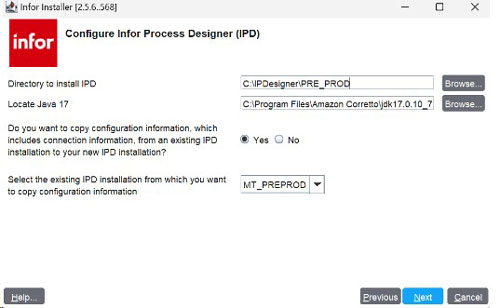
When installing Infor Process Designer, a new addition for install is that it is now asking for the Java 17 path. To complete the install, you will first have to download JDK 17 from Amazon Corretto and install it. Then verify that the install path is added to JAVA_HOME and Path environment variables.
Next, run the IPD installer and choose New Install. Select the directory to install IPD. Browse to the Java 17 location if it isn’t already populated.
The option to copy configuration information is now available. You can select “Yes” here and select the existing IPD configuration to copy.
Many businesses are transitioning to new enterprise resource planning (ERP) systems, whether to upgrade their current ones, move over to the cloud, or feel the need for change. The go-live phase is when everything in your ERP project comes to fruition – and the success of this stage makes or breaks your new system. ERP experts at Synavos share a guide on Medium.com on how to have a successful go-live and how to prepare for this transformative step.
Pre-Go-Live Preparations. “Preparation is key for a smooth ERP Go-Live. Before your launch date, you should have comprehensive testing, user training, and data migration strategies in place. This phase involves finalizing configurations, conducting user acceptance testing (UAT), and ensuring that everyone involved understands their roles.”
Train Your Team for Success. “Your team is your greatest asset, and their proper training is crucial for a successful Go-Live. Investing in user training can significantly impact how well your team adapts to the new ERP system.”
Data Migration Strategies. “Data integrity is vital during your ERP Go-Live. Effective data migration ensures that your new system has accurate, up-to-date information from the outset.”
Communication Is Key. “Effective communication throughout the Go-Live process cannot be overstated. Keeping all stakeholders informed about timelines, expectations, and any potential disruptions will go a long way.”
Go-Live Day: What to Expect. “On Go-Live day, emotions run high, and it’s natural to feel a mix of excitement and anxiety. Have a clear plan in place for the day, including a checklist of tasks and a designated support team ready to troubleshoot any issues.”
Post-Go-Live Support and Monitoring. “Once the dust settles, the real work begins. Monitoring system performance and user feedback closely after your ERP Go-Live is critical.”
As you finalize your plans for ERP Go-Live, Synavos wants us to remember that this phase is the beginning of a new chapter for your organization. Each step you take now contributes to a stronger, more efficient future.
Can you please open again program in Lawson Portal and once you open it, please do “CTRL+ALT+A” from your keyboard and send me the result it will show the XML file.
var vID = portalWnd.oUserProfile.getAttribute(“ID”);
var vNtID = portalWnd.oUserProfile.getAttribute(“lawsonuserlogin”);
var vMessage=”User Cannot Modify GL Entry”;
var vCompany=lawForm.getDataValue(“GLC-COMPANY”);
vCompany=portalWnd.strFillChar(vCompany,4,”left”,”0″);
var vFYear=lawForm.getDataValue(“GLC-FISCAL-YEAR”);
var vAPeriod=lawForm.getDataValue(“GLC-ACCT-PERIOD”);
var vSystem=lawForm.getDataValue(“GLC-SYSTEM”);
var vJeType=lawForm.getDataValue(“GLC-JE-TYPE”);
var vCountrolGrp=lawForm.getDataValue(“GLC-CONTROL-GROUP”);
var vJeSeq=lawForm.getDataValue(“GLC-JE-SEQUENCE”);
// build the DME call that will get the related asset number
var vDmeString = portalWnd.DMEPath;
vDmeString += “?PROD=DEVRY&FILE=GLCONTROL&FIELD=OPERATOR;&MAX=1&INDEX=GLCSET1”;
vDmeString += “&KEY=” + vCompany + “=” + vFYear + “=” + vAPeriod + “=” + vSystem + “=” + vJeType + “=” + vCountrolGrp + “=” + vJeSeq;
vDmeString += “&SELECT=OPERATOR=” + vNtID;
vDmeString += “&XCOLS=TRUE”;
vDmeString += “&OUT=XML”;
// send the DME call to the server
var vDMEInfo = portalWnd.httpRequest(vDmeString);
if (!vDMEInfo || vDMEInfo.status)
{
var msg=”Error calling DME, “;
msg += (vDMEInfo
? “(status code): “+vDMEInfo.status
: “bad server response.”);
lawForm.setMessage(msg);
alert(msg);
return false;
}
// create an XML object to contain the DME data
var vObjDMEXML = new portalWnd.DataStorage(vDMEInfo);
var vOpr=lawForm.getDataValue(“OPERATOR”);
// load a variable with the records returned by DME
var vRecords = vObjDMEXML.document.getElementsByTagName(“RECORD”);
if (vRecords.length != 1)
{
var vMsg = “Cannot Modify GL Entry”;
lawForm.setMessage(vMsg);
return false;
}
}
return true;
}
]]>
</XSCRIPT>
</form>
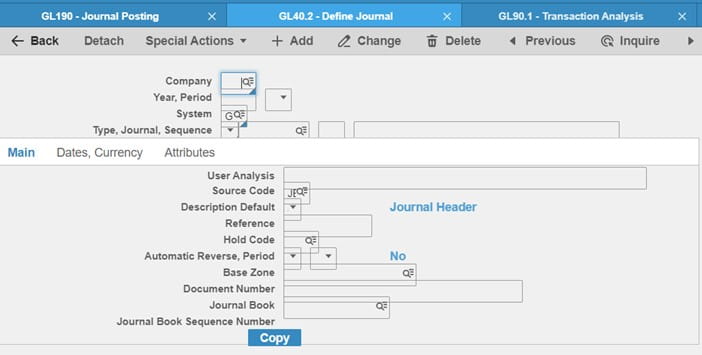
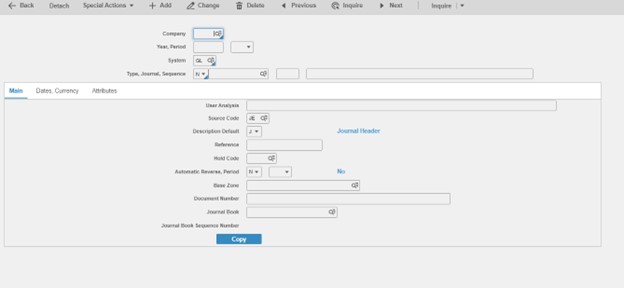
This shows the program is a Design Studio form formid=”GL40.2_CUSTOM”. The reason it didn’t show properly aligned to the Lawson Portal is because some of the size of the boxes did not match the Portal and DS form.
Resolution:
Run the analyzer tool from Lawson Portal.
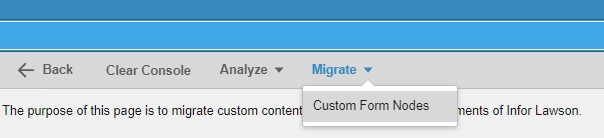
Go to Portal > Migrate Custom Content > Migrate Custom Content > Migrate>Custom Form Nodes
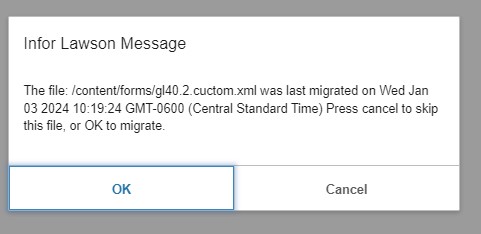
You will get Pop ups for the custom form to migrate.
Click ok
And then go to Portal and try your screen again. It should not have the right size.
https://www.nogalis.com/wp-content/uploads/2024/10/Lawson-form-is-not-sized-right-in-Portal.jpg470470Angeli Mentahttps://www.nogalis.com/wp-content/uploads/2013/04/logo-with-slogan-good.pngAngeli Menta2024-10-11 08:20:212024-10-07 15:28:47Lawson form is not sized right in Portal
A unique but not uncommon statistic that came in the wake of the Covid-19 pandemic was the amount of mergers and acquisitions (M&A) that occurred in the last four years. M&As have become a strategic imperative for many companies looking to bolster their market positions and expand their capabilities. Cybersecurity expert Tony Bradley shares an article on Forbes that highlights the increasing significance of cybersecurity in mergers and acquisitions. As companies pursue growth through M&A, they face heightened cybersecurity risks that can impact the success of these deals. The article outlines several key points, including:
Rising Threat Landscape: The digital landscape is evolving, with cyberattacks becoming not only more frequent but also more sophisticated. This includes advanced persistent threats (APTs), ransomware, and phishing schemes specifically targeting organizations during the M&A process. The awareness of these risks necessitates a robust evaluation of potential targets’ cybersecurity measures to mitigate risks associated with vulnerabilities that attackers might exploit during or after the acquisition. Companies must be proactive in understanding the threat environment and the specific vulnerabilities that may exist within the target’s infrastructure.
Due Diligence: Due diligence in M&A traditionally focused on financial, legal, and operational considerations. However, in today’s environment, cybersecurity has emerged as a critical factor in the due diligence process. Companies are increasingly required to conduct comprehensive cybersecurity audits and assessments to uncover potential issues—such as data breaches or inadequate security practices—that could pose risks post-acquisition. This may involve reviewing the target’s cybersecurity policies, incident response plans, compliance with standards, and historical data breach incidents. Identifying these vulnerabilities early can inform negotiations, affect deal value, and ultimately protect the acquiring company’s interests.
Integration Challenges: After the merger, integrating two organizations often presents significant cybersecurity challenges. Differences in cultures, security protocols, network architecture, and technologies can create disparities that may become points of vulnerability. Effective integration means aligning the cybersecurity policies and practices of both entities to create a unified strategy that protects against potential threats. This can include the implementation of consistent security policies across both organizations, joint training programs for employees, and the harmonization of security technologies. Neglecting these factors can lead to gaps in security posture and increased exposure to cyber threats.
Regulatory Compliance: As regulations surrounding data protection and privacy become more stringent (e.g., GDPR, CCPA), companies must recognize the legal implications of inadequate cybersecurity during M&A activities. Non-compliance can lead to significant fines and reputational damage in addition to affecting the transaction itself. Companies need to ensure that both they and their potential acquisition targets adhere to pertinent regulations by prioritizing cybersecurity in their M&A strategies. Integrating compliance considerations into the M&A process requires maintaining an ongoing dialogue between legal, financial, and IT teams to ensure that all aspects of regulatory requirements are addressed.
Investment in Cybersecurity: As companies acknowledge the critical importance of cybersecurity, there has been a marked increase in investment in security infrastructure and capabilities. This includes implementing advanced security technologies (such as intrusion detection systems, encryption, and identity management), enhancing training programs for employees, and establishing incident response teams. Protecting intellectual property and sensitive customer data is essential during M&A transactions, as these assets significantly contribute to a company’s value. Demonstrating a robust cybersecurity framework can not only safeguard assets but also enhance the acquiring company’s reputation and trustworthiness in the eyes of stakeholders.
Cybersecurity is no longer an afterthought in the M&A process; instead, it should be an integral consideration at every step of the journey—from initial assessments of targets to the final integration of organizations. Emphasizing comprehensive, well-coordinated cybersecurity strategies will safeguard investments and ensure the resilience and success of the combined entities in an increasingly volatile digital landscape.
https://www.nogalis.com/wp-content/uploads/2024/10/business-meeting-merger-acquisition-handshake.jpg300450Angeli Mentahttps://www.nogalis.com/wp-content/uploads/2013/04/logo-with-slogan-good.pngAngeli Menta2024-10-10 13:33:212024-10-11 11:04:21The Growing Importance Of Cybersecurity In Mergers And Acquisitions
As organizations migrate to the cloud, cybersecurity threats have grown, making security a top priority. This shift is driven by the realization that data breaches can have devastating financial and reputational impacts. Businesses are now prioritizing the protection of sensitive data, often opting to invest more in security measures despite potentially higher costs. David S.Linthicum, industry expert and thought leader, shares an article on Infoworld.com on why cloud security typically prioritizes and outranks cost and scalability for some companies. Linthicum explains how the shift in prioritizing cloud security over cost and scalability is a significant trend driven by several factors. Some include: rising cyberthreats, complex cloud environments, compliance and regulatory pressures, reputation, long-term cost implications, innovation and agility. “This landscape is driving businesses to adopt a ‘security-first’ mindset,” he notes.” Although this can be a platitude, we must recognize that other benefits of cloud computing—cost savings and scalability—can be undermined without good security planning and mechanisms. This shift mirrors a broader global movement toward valuing resilience and reliability alongside traditional operational metrics.”
How can companies keep security and cloud costs within a reasonable budget? Balancing cloud costs with security involves strategic approaches to optimize resources while safeguarding systems and data, Linthicum explains. “This directly correlates with the price of the cloud versus the value of security, and they are not often that easy to connect. Many assume that the more security you’ll need, the higher the cost of the cloud services.” However, he has found that in many instances that the opposite is true.
Below are Linthicum’s words of advice to help you find value in security and move away from the accepted mentality that more security always means more money.
Build security into the architecture from the start to avoid expensive fixes later. This seems obvious but it’s often not done. Security is an afterthought about half the time, and companies then are forced to toss money at the problem.
Automate compliance and management to reduce manual efforts and costs. Automation means repeating good processes without depending on humans; security is no different.
Use strong access controls to ensure only authorized users access critical data. Identity management is the most used approach here, and for good reason.
Regularly audit cloud usage to eliminate wasteful spending and optimize resource allocation. Also, train teams to efficiently manage cloud resources and security.
If you’re in Lawson on PO20 and you’re trying to delete a PO, you may sometimes come across the following error message, “Cannot delete, line ###### has been issued”.
There is a reason why you cannot delete and a workaround for it. The reason for it not being able to be deleted is that unfortunately, since the PO has been issued, the vendor has a copy of that PO. This means that it is a binding document. It cannot be deleted. It needs to be kept in the system so that it can be referenced if the vendor should call about it. The only action you can take is that the PO can be canceled instead.
https://www.nogalis.com/wp-content/uploads/2024/10/Lawson-PO20-Error-Cannot-delete-line-has-been-issued.jpg470470Angeli Mentahttps://www.nogalis.com/wp-content/uploads/2013/04/logo-with-slogan-good.pngAngeli Menta2024-10-08 09:13:382024-10-07 15:18:11Lawson PO20 Error – Cannot delete line ###### has been issued
Cloud storage has revolutionized the data space. This managed service offers a range of benefits including cost savings, improved data accessibility, and offering robust backup and recovery options. With this however, cloud environments are also becoming more complex and challenging for businesses. Having all this sensitive information in the cloud could be a vulnerable target for cyber attacks if we don’t properly secure our data in the cloud. To address these risks, it is paramount that companies ensure their security measures are strong. An article on Technology Magazine shared by tech expert Amber Jackson shares the insights of executives from KPMG, IBM, Kyndryl and Persistent Systems as they comment how the current cybersecurity landscape is evolving in line with cloud storage developments.
Adapting to a changing security landscape. “The cloud landscape keeps changing and becoming more complex, with legacy systems unable to handle today’s new threat environments. With AI adoption continuing to rise and data being central to enterprise success, data security is becoming a more significant concern for businesses. In response, the security landscape is evolving in tandem with these cloud storage concerns, with organizations moving to protect the data of its workforce and clients. As Nataraj Nagaratnam, Global CTO for Cloud Security at IBM, explains, concerns like data theft are currently a leading cloud security threat. ‘Effectively addressing and preventing data theft requires a data-centric security, compliance and resilience strategy,’ he says. ‘Cloud providers have a responsibility to not only monitor the threat landscape but provide their clients with the necessary technology to protect the data they are entrusted with.’ Additionally, Ben Scowen, Vice President UK&I Cloud & Core Leader at Kyndryl, notes that businesses must evolve to embrace new cloud-based technologies – which involves changing the benchmarks for security. ‘The cybersecurity landscape has significantly expanded to accommodate evolving IT environments,’ he explains. ‘Although organizations have invested in layered, in-depth security point solutions, the siloed approach makes it difficult to grapple with the growing sophistication and frequency of cyberattacks.'”
Embracing data regulations. “‘We have moved into a data-centric world,’ Nataraj explains. “Enterprises need to stay on top of regulations that focus on data privacy and data resilience. As businesses attempt to manage the complex regulatory landscape, they can employ a sovereign cloud approach to ensure their data can remain in-country, up and running at all times, assure data privacy or comply with the latest regulations.” Additionally, Scowen notes that businesses need to be mindful of these regulations when they’re designing or implementing new systems, ensuring they adopt a “secure by design” mindset. ‘Data protection in data processing procedures is best adhered to when it is already integrated into the technology.'”
Leveraging cloud storage to gain insights. “With a robust data foundation, businesses can leverage analytics to gain insights from data sources such as the Internet of Things (IoT). ‘IoT devices collect huge amounts of data, only some of which is ordinarily used for analytics,’ explains Adrian Bradley, Head of Cloud Transformation at KPMG. ‘Cloud storage and analytics hold the key to unlocking the valuable insights in this data. This may be on pricing, customer behaviour and competitors, while also supporting preventative measures against fraud and ransomware.’ However, having a clear cybersecurity strategy remains important to protect sensitive IoT data that can be exploited. ‘Choosing the right cloud service provider is key, ensuring businesses can efficiently store, manage, and access vast amounts of data,’ Barath Narayanan, Global BFSI and Europe Geo Head at Persistent Systems, suggests. ‘Optimizing data placement ensures that information is stored as close as possible to where it will be processed, minimizing latency and enhancing overall system performance.’
https://www.nogalis.com/wp-content/uploads/2024/06/technology-network-cloud-it.jpg315475Angeli Mentahttps://www.nogalis.com/wp-content/uploads/2013/04/logo-with-slogan-good.pngAngeli Menta2024-10-07 15:23:442024-10-04 16:50:58The Threat Against Cloud Storage: Protecting Digital Systems
In Lawson Security, you may come across a problem where no programs are found with any securable types enabled. This is a simple fix. Follow the steps below to learn how to fix security not registering Lawson (when given all securable types):
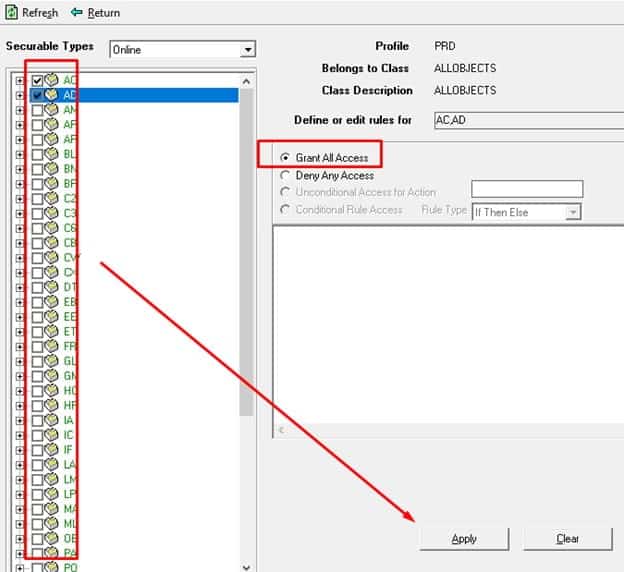
When editing the class select Add Rule, then in the Securable Types Online, add all top system codes (HR, AP, TE etc.) as shown below:
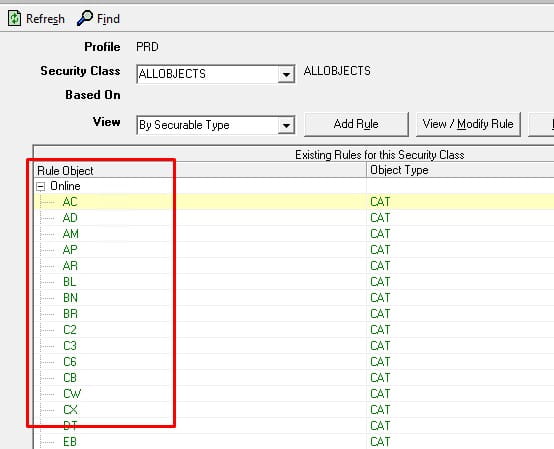
Next, you will need to validate that the objects are added:
Clear Server cache in LSA, Clear IOS cache in Portal.
Logout then log back in and test again. This should enable all and solve the issue.
This sort of task is commonly handled by a Lawson functional resource. Many organizations opt to engage a team of Lawson consultants who provide managed services for a fixed monthly fee. These consultant teams possess extensive expertise and diverse knowledge, making them suitable for large-scale enterprises. However, they are equally beneficial for smaller organizations that do not require a dedicated Lawson employee onsite. Nogalis provides such services, and we welcome you to reach out to us through our contact page.
https://www.nogalis.com/wp-content/uploads/2022/11/Lawson-Security-No-Programs-Found-with-All-Securable-Types-enabled.jpg470470Angeli Mentahttps://www.nogalis.com/wp-content/uploads/2013/04/logo-with-slogan-good.pngAngeli Menta2024-10-04 10:59:022024-10-04 13:55:33Lawson Security – No Programs Found with All Securable Types enabled
This week Infor have kicked off their Velocity Summit in Las Vegas, NV. They shared updates to its industry-specific CloudSuite portfolio on the first day. Per the press release, each new innovation, including a GenAI Assistant, process mining capabilities, and ESG Strategy Management, meaningfully enhances Infor’s suite of industry-specific products built to drive value. Infor developed its multi-tenant CloudSuite tech stacks with out-of-the-box hyper-specific capabilities, redesigning the way organizations work and helping to reduce risk. Infor offers industry specific automations, leveraging AI and machine learning, which are pre-configured solutions that customers can easily deploy without disruption to core systems – as a means to further drive value.
Key updates of Infor’s October release include:
Turning conversations into business clarity with new GenAI Assistant and additional embedded experiences.
Providing enhanced, accelerated visibility into business processes with Infor Process Mining.
Helping customers stay on top of new compliance regulations with new modules for ESG Strategy Management and Execution.
Industry-specific supply chain management enhancements help improve supply chain accuracy, reduce manual intervention, and speed time to value.
Infor invites businesses to follow along in the conversation at its two Velocity Summit customer events, in Las Vegas from Oct. 1-2 and in Amsterdam from Oct. 22-23 with the hashtag #InforVelocitySummit
https://www.nogalis.com/wp-content/uploads/2024/10/business-meeting-company.jpg333500Angeli Mentahttps://www.nogalis.com/wp-content/uploads/2013/04/logo-with-slogan-good.pngAngeli Menta2024-10-03 15:02:212024-10-04 16:50:13Infor Targets Business Velocity with Added Process Mining, ESG and GenAI Capabilities