
For years there has been talk in the IT world that most server workloads will eventually move to the cloud because of the economies of scale advantages. The centralized Enterprise Resource Planning (ERP) suite has resisted until now, showing signs that ERP is finally succumbing to cloud computing.

“We have reached a tipping point with cloud ERP,” says Rebecca Wettemann, vice president of research for Nucleus. “A lot of companies are getting to the point where their next ERP upgrade is almost a re-implementation, so they’re looking at their other options.”

According to Wettemann, cloud options are available in almost all ERP packages. “All of them have options for some version of hosting, certainly,” Wettemann says. “But I think we’ll see more and more” adopt the cloud delivery model going forward.


 For Full Article, Click Here

Businesses these days could benefit greatly from social collaboration within enterprise resource planning (ERP) solutions. Today’s ERP systems should engage employees, customers, partners, suppliers and constituents within a business. It’s about a company becoming more responsive, reacting to challenges quicker, and leveraging all the information you’ve gathered in the past to avoid future problems in order to stay competitive in today’s business environment. ERP collaboration is even simpler these days since these platforms have social collaboration tools integrated. Users of the ERP systems can participate across every department, bringing employees together to share their expertise and increase productivity. Collaboration is a competitive advantage that is essential for the future prosperity of any company.

For Full Article, Click Here

Working in partnership with Amazon Web Services, Infor is targeting suppliers and warehouse operators with the release of Supply Chain Execution (SCE) to the cloud.  The product will allow customers to manage their warehouses, workers, third-party logistics billing and transport in a cloud program.

“Infor SCE has taken this next major step forward creating a reliable cloud solution that is both an affordable and flexible tool for creating efficiency within the supply chain,” says John Bermudez, VP of product management at Infor.

SCE will also grant users access to Infor’s collaboration tool Ming.le, and the company’s Intelligent Open Network (ION), which helps integrate applications from different vendors.


 For Full Article, Click Here

Enterprise Resource Planning (ERP) is more than a platform that makes it easier to handle data pertaining relevant information to purchases, sales, accounting, manufacturing, and more. It ultimately serves as a tool for ensuring customer satisfaction.

ERP software helps to ensure customer satisfaction by making business operations more relevant. The data obtained creates for better analysis and presentation of the company’s actual customer behavior, so a business is able to provide better services or offer better products to customers.

ERP provides customer satisfaction through:

  • Integration of Best Practices
  • Inventory Control and Availability Tracking
  • Improving Customer Handling
  • Improved Efficiency Through Automation
  • Improved Visibility

Better handling of business data to make it useful in business operations will result in better products or services and improved handling of customer concerns. It’s about using the data gathered to make impactful decisions.

For Full Article, Click Here

Infor has announced the Enterprise Asset Management (EAM) version 11.1 to help improve asset management during the entire lifespan of business-critical assets and equipment. This update provides a wide range of capabilities to quickly and economically manage assets via cloud, on-premise, or hybrid deployment. Infor EAM 11.1 also enables greater accessibility for users to connect to the enterprise on the go, using their mobile devices and tablets.

“Infor Enterprise Asset Management has been an integral part of many different business applications since its development,” said Scott Bannon, president of the User Advisory Board. “Through continuous improvements and investments, Infor EAM 11.1 allows for more connectivity and visibility throughout all touch points of the operation. The new program allows companies to make better use of time and resources, providing an all-around solution to many daily problems.”


For Full Article, Click Here


The CRM Platform, Microsoft Dynamics, has had over 40 quarters of double-digit growth, according to Microsoft. However, the Dynamics ERP sector is still not at it’s maturity to offer a production-ready public cloud offering. Microsoft technician Michael Ehrenberg explains the hold up being the ongoing work on a “Premium Storage option backed by fast drives and streamlined data access that will ensure fast performance within service-level agreements.” It may be that Microsoft is already successful in their CRM and marketing applications that ERP is still in the back burner, though Microsoft should consider pushing their ERP application since these days, having a solid ERP system is viable for a good company’s overall business strategy.


For Full Article, Click Here


Google’s updated query platform, the Knowledge Graph, now includes a breakdown of healthcare-related queries to medical conditions and their common symptoms, treatments, and age breakdown statistics. This update will create a better patient experience for those searching on a broad keyword set. The user-friendly content research will help a patient find what they’re looking for as easy and informative as possible. Regarding search results, pharma brands won’t see much of an impact in organic search, but the possibility with Google backing this up is still on the table.


For Full Article, Click Here

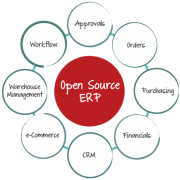
Why do large companies use open source Enterprise Resource Planning (ERP) systems? The short answer: it’s cheaper and easier to customize.

Open source ERP typically have no license or software maintenance costs, eliminating a great sum of fees. This also makes consultant and programmer fees are much lower. Commercial ERP systems most often require costly databases and operating systems. Implementing an open source ERP system for a large organization is easily done, with a new interface shell created outside the core system, meeting the business needs. Open source ERP provides full source content, no need for lock-in or vendor dependency.

Of course there are some disadvantages with open source, though if you want a general ERP system that’ll do what you need and not feel as complicated, open source is a good option.

For Full Article, Click Here

Enterprises are able to reduce costs on hardware, maintenance and tech support through the migration of data, apps and infrastructure to the cloud. Chris Nerney, Information Technology writer, states that by “placing compute resources on a cloud platform that is easily accessible on any device, enterprises make it easier for developers to build and collaborate on applications”. Cloud storage is also a worry-free concern for server capacity and expenditures. Additionally, Nerney believes that the most critical aspect of the cloud is that it provides the ideal platform for collecting and analyzing big data, all in real time. He concludes, “As data continues to grow exponentially, cloud computing will become a strategic imperative”.

For Full Article, Click Here

The maturing Customer Relationship Management (CRM) market is a desirable market for consumer data. However, over time, simply collecting this data gives organizations their first potential for a ticking time bomb. The CRM gets clogged up and polluted with dated and incomplete contact records. Decayed and dirty data in CRM systems and contact databases is costing businesses lots of money each year they do not clean it up, through penalties, brand damage and more. “Poor record keeping, poor security and a failure to comply with consumer requests are risks a business would be crazy to ignore,” says Ben Rossi, business and technology writer. “ The longer you ignore data quality, the worse it will get.”

For Full Article, Click Here