
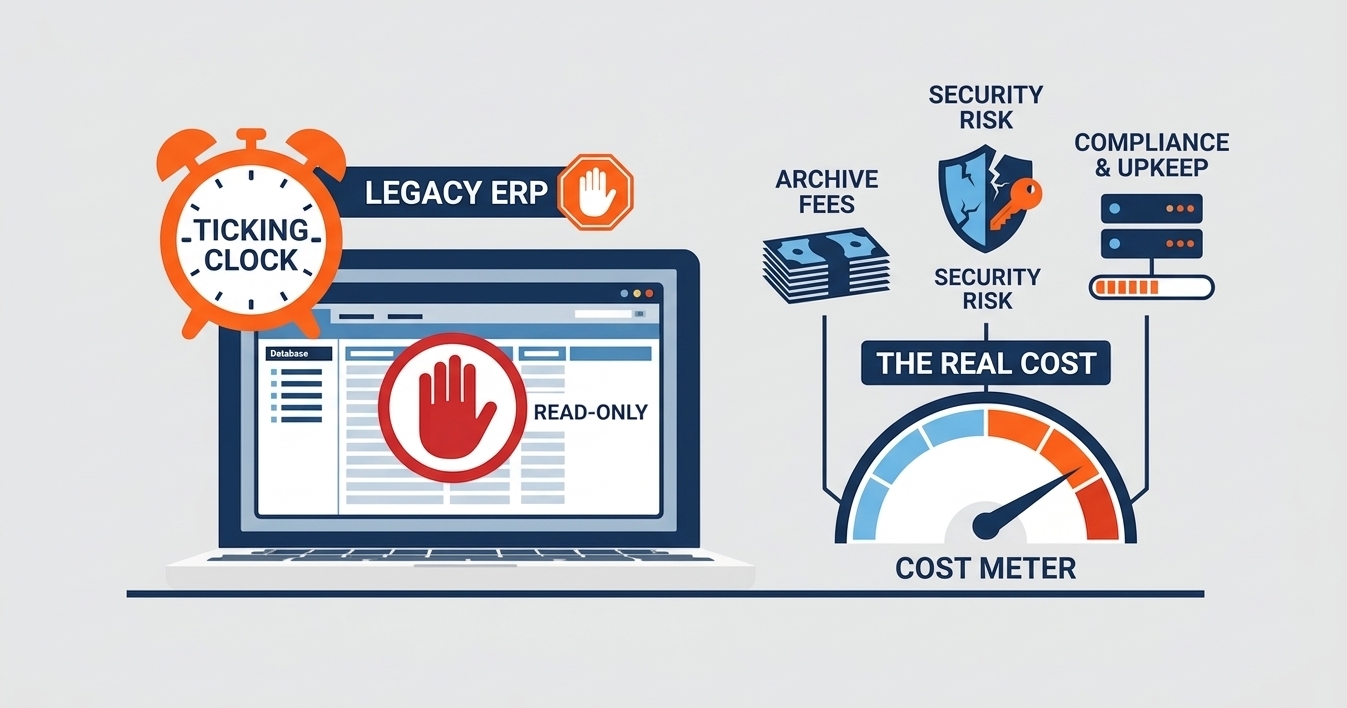
The Real Cost of Keeping a Legacy ERP Alive Just for Read-Only Access
Most organizations that move to a new ERP don’t actually retire the old one. They “keep it around for history.” Five years later it’s still there, still patched, still on the DR plan, still consuming a chunk of an administrator’s week, and nobody can say what it costs.
Here’s the bill, line by line, for a legacy Lawson, PeopleSoft, or Oracle EBS instance running in read-only mode. If you’re the application manager who inherited it, this is the number to bring to the budget meeting.
The visible costs
Vendor maintenance. If you still pay the software vendor for support on a system nobody transacts in, that’s the biggest line and the easiest to cut. Many organizations keep paying because they’re afraid of losing access to patches for a system they never patch.
Hosting. On-prem, that’s servers, storage, and a database license (Oracle or SQL Server) that has to stay licensed even for read-only use. Hosted, it’s a monthly bill from a managed services provider that hasn’t gone down just because usage did. For a mid-size Lawson environment, hosting alone commonly runs $100K–$250K a year.
Database licensing. Often forgotten: the ERP is read-only, but the Oracle or SQL Server underneath it isn’t free, and neither are the OS licenses on the servers.
The invisible costs
Administrator time. Someone still has to apply OS patches, renew certificates, manage the LDAP bind, rotate service account passwords, and answer the “I can’t log in to the old system” tickets. Across the Lawson environments we manage, read-only systems still generate 20–40 tickets a year. That’s real hours from a person who knows the system, and those people are getting harder to find.
Security exposure. A legacy ERP that isn’t being actively maintained is a legacy ERP with unpatched middleware — WebSphere, an old Java runtime, an Infor OS or PeopleTools release that’s past its own support window. It’s on your network, it holds every employee’s SSN and bank account, and it’s the softest target you own.
Audit and compliance. Every SOC 2, HIPAA, or financial audit asks about systems that hold sensitive data. Every one of them adds the legacy ERP to the scope. Access reviews, evidence collection, and the inevitable finding that a terminated employee still had an account.
DR and backups. The old system is still on the backup schedule and still in the DR runbook. Nobody has tested restoring it in years.
Knowledge risk. The one person who knows how to restart the Lawson environment when the job scheduler hangs retires next year.
Adding it up
For a typical mid-size organization the read-only legacy ERP, fully loaded, runs somewhere between $200K and $500K a year. That figure comes from the hosting and support contracts we see when clients come to us, plus a conservative allocation of internal time. The number is almost never in one budget line, which is why it survives year after year.
Against that, an application archive that replaces the whole stack — data, attachments, security, and reports — typically costs under $75,000 a year on a three-year term, with no servers, no database license, and no administrator. APIX runs serverless in your own AWS account; the AWS consumption cost for a multi-terabyte archive that gets queried a few hundred times a month is usually a few hundred dollars.
The payback on a decommission isn’t a nuanced calculation. It’s the first year.
What you’re actually paying for
Worth being honest about what the legacy system still provides, because the archive has to provide the same things or the decommission fails:
- Lookups: “What did we pay this vendor in 2018?” “What was this employee’s rate history?”
- Audit responses: pulling payroll registers or GL detail for a specific period on demand.
- Legal holds and discovery: producing records for a specific person or date range.
- Regulatory retention: the data has to exist somewhere for the required period (see our post on retention requirements by industry).
None of those need the ERP. They need the data, a way to search it, and a way to control who searches it.
Where to start
Pull three numbers: the vendor maintenance invoice, the hosting or infrastructure cost, and an honest estimate of admin hours. If the total is over $100K a year — and it almost always is — the legacy system is the most expensive read-only database you own.
Book a discovery session and we’ll put together the comparison for your environment, with the actual AWS cost estimate for your data volume.
Retiring Lawson, PeopleSoft, or Oracle? APIX archives the entire application — every table, every year, attachments and security included — into your own AWS account in about 30 days, so you can decommission the legacy system and keep full access to the history.

